

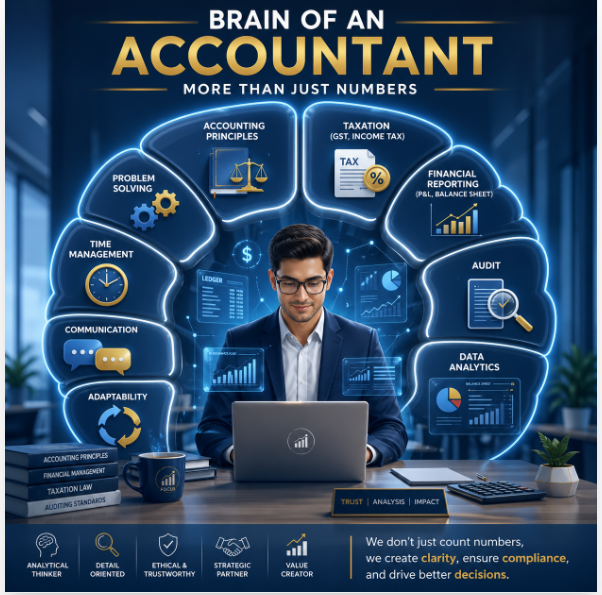
Brain of an Accountant – More Than Just Numbers
The Accountant’s Real Value Isn’t in Numbers
Introduction
When most people think of an accountant, they picture someone working with spreadsheets, calculators, and financial statements.
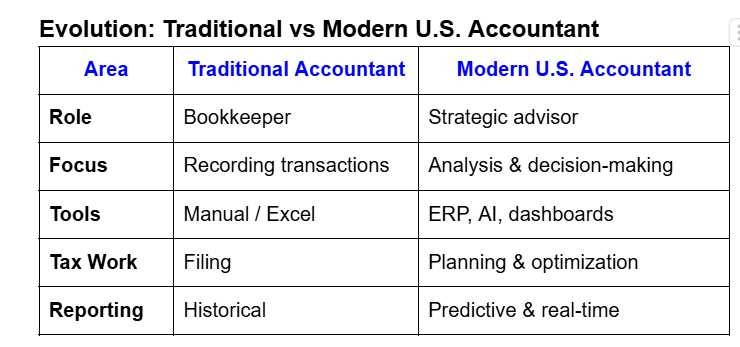
But in the United States, the role of an accountant has evolved far beyond bookkeeping.
Today’s accountant operates at the intersection of:
- Compliance
- Technology
- Strategy
- Advisory
A modern U.S. accountant is not just a number-cruncher — they are a financial architect, risk manager, and business advisor.
Why the Role of an Accountant Is More Complex in the U.S.
The U.S. financial ecosystem is one of the most regulated and dynamic in the world. Accountants must navigate:
- U.S. GAAP standards set by Financial Accounting Standards Board
- Federal and state tax systems governed by Internal Revenue Service
- Audit and compliance frameworks overseen by Public Company Accounting Oversight Board
- Multi-state taxation complexities post South Dakota v. Wayfair (Nexus establish)
This makes the accountant’s role not only technical but also highly analytical and strategic.
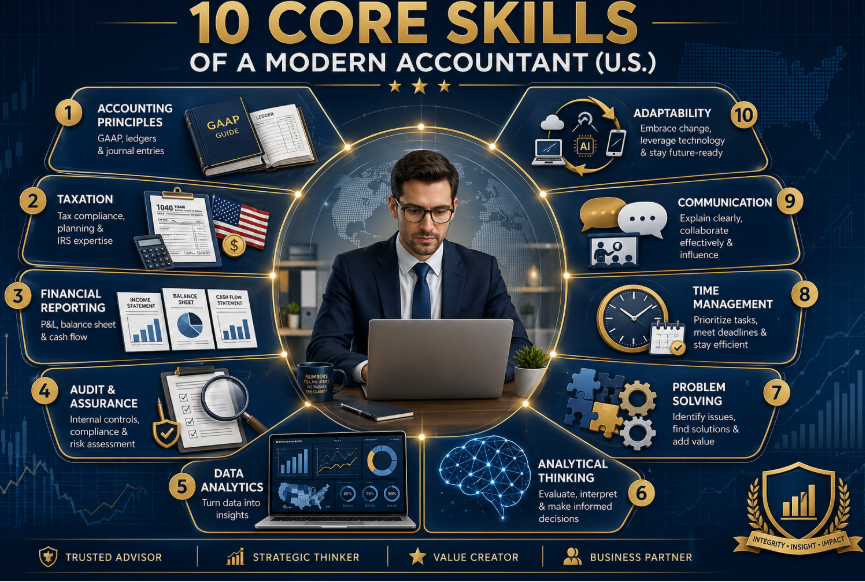
Core Competencies of a Modern U.S. Accountant
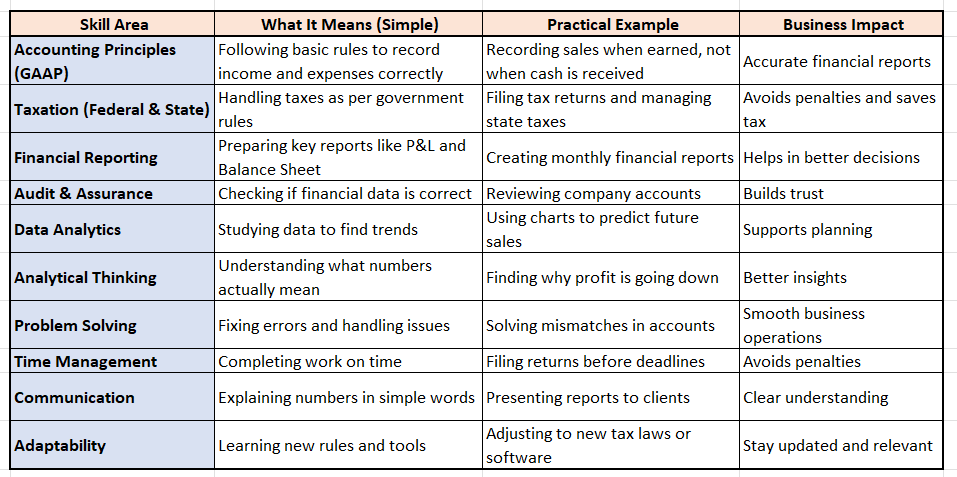
Deep Dive: What Makes These Skills Critical
1. Accounting Principles: The Foundation of Trust
Without proper application of GAAP, financial statements lose credibility.
Revenue recognition under ASC 606, for example, requires judgment — not just data entry.
2. Taxation: More Than Filing Returns
U.S. taxation is complex due to:
- Federal vs State differences
- Nexus rules
- Payroll and compliance layers
A skilled accountant doesn’t just file returns — they plan and optimize taxes.
3. Financial Reporting: Turning Data into Decisions
Financial reports are not just compliance documents.
They help answer:
- Is the business profitable?
- Is cash flow stable?
- Where should we invest?
4. Audit & Assurance: Building Market Confidence
Audits ensure transparency and reliability, especially for:
- Investors
- Lenders
- Regulators
Without proper assurance, financial data loses trust.
5. Data Analytics: The Competitive Advantage
Modern accountants use:
- Dashboards
- Forecasting tools
- Trend analysis
This transforms them into decision-makers, not just record-keepers.
6. Analytical Thinking: The Real Differentiator
Numbers alone don’t create value — insights do.
Example:
A decline in profit could indicate:
- Rising costs
- Inefficient operations
- Pricing issues
An accountant’s job is to interpret and advise.
7. Problem Solving: Where Real Value Lies
From IRS notices to reconciliation errors, challenges are constant.
A great accountant:
- Diagnoses issues quickly
- Applies logic and regulation
- Provides solutions
8. Time Management: Compliance Is Deadline-Driven
U.S. accounting runs on strict deadlines:
- April 15 (individual tax returns)
- Corporate filings
- Audit timelines
Missing deadlines = penalties + reputational risk.
9. Communication: Bridging Finance and Business
An accountant must translate:
- Complex financial data
→ into - Simple, actionable insights
This is what makes them a trusted advisor.
10. Adaptability: The Future-Proof Skill
With:
- Changing IRS rules
- Automation & AI
- Cloud accounting systems
Continuous learning is mandatory.
Conclusion: Beyond Numbers
The modern U.S. accountant is no longer measured by how well they manage numbers —
but by how effectively they translate those numbers into business value.
They operate as:
- Compliance experts, ensuring adherence to regulations set by bodies like the Internal Revenue Service
- Strategic thinkers, aligning financial data with long-term business goals
- Problem solvers, navigating complexity with clarity and precision
- Trusted advisors, guiding decisions that shape the future of a business
In today’s dynamic environment, an accountant’s true value lies in:
- The ability to analyze data and uncover meaningful insights
- The capability to solve real-world financial challenges efficiently
- The skill to communicate complex information with clarity and impact
Numbers are just the starting point.
Insight is the outcome. Value is the goal.
Shweta Goyal, CA, CPA
CA | CPA (License Awaited) | Expert in U.S. Taxation, Accounting, Auditing, and Regulatory Compliance

Brain of an Accountant – More Than Just Numbers
The Accountant’s Real Value Isn’t in Numbers
Introduction
When most people think of an accountant, they picture someone working with spreadsheets, calculators, and financial statements.
But in the United States, the role of an accountant has evolved far beyond bookkeeping.
Today’s accountant operates at the intersection of:
- Compliance
- Technology
- Strategy
- Advisory
A modern U.S. accountant is not just a number-cruncher — they are a financial architect, risk manager, and business advisor.
Why the Role of an Accountant Is More Complex in the U.S.
The U.S. financial ecosystem is one of the most regulated and dynamic in the world. Accountants must navigate:
- U.S. GAAP standards set by Financial Accounting Standards Board
- Federal and state tax systems governed by Internal Revenue Service
- Audit and compliance frameworks overseen by Public Company Accounting Oversight Board
- Multi-state taxation complexities post South Dakota v. Wayfair (Nexus establish)
This makes the accountant’s role not only technical but also highly analytical and strategic.
Core Competencies of a Modern U.S. Accountant
Deep Dive: What Makes These Skills Critical
1. Accounting Principles: The Foundation of Trust
Without proper application of GAAP, financial statements lose credibility.
Revenue recognition under ASC 606, for example, requires judgment — not just data entry.
2. Taxation: More Than Filing Returns
U.S. taxation is complex due to:
- Federal vs State differences
- Nexus rules
- Payroll and compliance layers
A skilled accountant doesn’t just file returns — they plan and optimize taxes.
3. Financial Reporting: Turning Data into Decisions
Financial reports are not just compliance documents.
They help answer:
- Is the business profitable?
- Is cash flow stable?
- Where should we invest?
4. Audit & Assurance: Building Market Confidence
Audits ensure transparency and reliability, especially for:
- Investors
- Lenders
- Regulators
Without proper assurance, financial data loses trust.
5. Data Analytics: The Competitive Advantage
Modern accountants use:
- Dashboards
- Forecasting tools
- Trend analysis
This transforms them into decision-makers, not just record-keepers.
6. Analytical Thinking: The Real Differentiator
Numbers alone don’t create value — insights do.
Example:
A decline in profit could indicate:
- Rising costs
- Inefficient operations
- Pricing issues
An accountant’s job is to interpret and advise.
7. Problem Solving: Where Real Value Lies
From IRS notices to reconciliation errors, challenges are constant.
A great accountant:
- Diagnoses issues quickly
- Applies logic and regulation
- Provides solutions
8. Time Management: Compliance Is Deadline-Driven
U.S. accounting runs on strict deadlines:
- April 15 (individual tax returns)
- Corporate filings
- Audit timelines
Missing deadlines = penalties + reputational risk.
9. Communication: Bridging Finance and Business
An accountant must translate:
- Complex financial data
→ into - Simple, actionable insights
This is what makes them a trusted advisor.
10. Adaptability: The Future-Proof Skill
With:
- Changing IRS rules
- Automation & AI
- Cloud accounting systems
Continuous learning is mandatory.
Conclusion: Beyond Numbers
The modern U.S. accountant is no longer measured by how well they manage numbers —
but by how effectively they translate those numbers into business value.
They operate as:
- Compliance experts, ensuring adherence to regulations set by bodies like the Internal Revenue Service
- Strategic thinkers, aligning financial data with long-term business goals
- Problem solvers, navigating complexity with clarity and precision
- Trusted advisors, guiding decisions that shape the future of a business
In today’s dynamic environment, an accountant’s true value lies in:
- The ability to analyze data and uncover meaningful insights
- The capability to solve real-world financial challenges efficiently
- The skill to communicate complex information with clarity and impact
Numbers are just the starting point.
Insight is the outcome. Value is the goal.
Shweta Goyal, CA, CPA
CA | CPA (License Awaited) | Expert in U.S. Taxation, Accounting, Auditing, and Regulatory Compliance

Brain of an Accountant – More Than Just Numbers
The Accountant’s Real Value Isn’t in Numbers
Introduction
When most people think of an accountant, they picture someone working with spreadsheets, calculators, and financial statements.
But in the United States, the role of an accountant has evolved far beyond bookkeeping.
Today’s accountant operates at the intersection of:
- Compliance
- Technology
- Strategy
- Advisory
A modern U.S. accountant is not just a number-cruncher — they are a financial architect, risk manager, and business advisor.
Why the Role of an Accountant Is More Complex in the U.S.
The U.S. financial ecosystem is one of the most regulated and dynamic in the world. Accountants must navigate:
- U.S. GAAP standards set by Financial Accounting Standards Board
- Federal and state tax systems governed by Internal Revenue Service
- Audit and compliance frameworks overseen by Public Company Accounting Oversight Board
- Multi-state taxation complexities post South Dakota v. Wayfair (Nexus establish)
This makes the accountant’s role not only technical but also highly analytical and strategic.
Core Competencies of a Modern U.S. Accountant
Deep Dive: What Makes These Skills Critical
1. Accounting Principles: The Foundation of Trust
Without proper application of GAAP, financial statements lose credibility.
Revenue recognition under ASC 606, for example, requires judgment — not just data entry.
2. Taxation: More Than Filing Returns
U.S. taxation is complex due to:
- Federal vs State differences
- Nexus rules
- Payroll and compliance layers
A skilled accountant doesn’t just file returns — they plan and optimize taxes.
3. Financial Reporting: Turning Data into Decisions
Financial reports are not just compliance documents.
They help answer:
- Is the business profitable?
- Is cash flow stable?
- Where should we invest?
4. Audit & Assurance: Building Market Confidence
Audits ensure transparency and reliability, especially for:
- Investors
- Lenders
- Regulators
Without proper assurance, financial data loses trust.
5. Data Analytics: The Competitive Advantage
Modern accountants use:
- Dashboards
- Forecasting tools
- Trend analysis
This transforms them into decision-makers, not just record-keepers.
6. Analytical Thinking: The Real Differentiator
Numbers alone don’t create value — insights do.
Example:
A decline in profit could indicate:
- Rising costs
- Inefficient operations
- Pricing issues
An accountant’s job is to interpret and advise.
7. Problem Solving: Where Real Value Lies
From IRS notices to reconciliation errors, challenges are constant.
A great accountant:
- Diagnoses issues quickly
- Applies logic and regulation
- Provides solutions
8. Time Management: Compliance Is Deadline-Driven
U.S. accounting runs on strict deadlines:
- April 15 (individual tax returns)
- Corporate filings
- Audit timelines
Missing deadlines = penalties + reputational risk.
9. Communication: Bridging Finance and Business
An accountant must translate:
- Complex financial data
→ into - Simple, actionable insights
This is what makes them a trusted advisor.
10. Adaptability: The Future-Proof Skill
With:
- Changing IRS rules
- Automation & AI
- Cloud accounting systems
Continuous learning is mandatory.
Conclusion: Beyond Numbers
The modern U.S. accountant is no longer measured by how well they manage numbers —
but by how effectively they translate those numbers into business value.
They operate as:
- Compliance experts, ensuring adherence to regulations set by bodies like the Internal Revenue Service
- Strategic thinkers, aligning financial data with long-term business goals
- Problem solvers, navigating complexity with clarity and precision
- Trusted advisors, guiding decisions that shape the future of a business
In today’s dynamic environment, an accountant’s true value lies in:
- The ability to analyze data and uncover meaningful insights
- The capability to solve real-world financial challenges efficiently
- The skill to communicate complex information with clarity and impact
Numbers are just the starting point.
Insight is the outcome. Value is the goal.
Shweta Goyal, CA, CPA
CA | CPA (License Awaited) | Expert in U.S. Taxation, Accounting, Auditing, and Regulatory Compliance

Building the underlying operating system for the autonomous enterprise. Powering the next generation
of business leaders.

© 2026 PERSTOC.AI ALL RIGHTS RESERVED.