

Building an AI-First Organization
Strategic insights for leaders integrating AI into sales and operations.
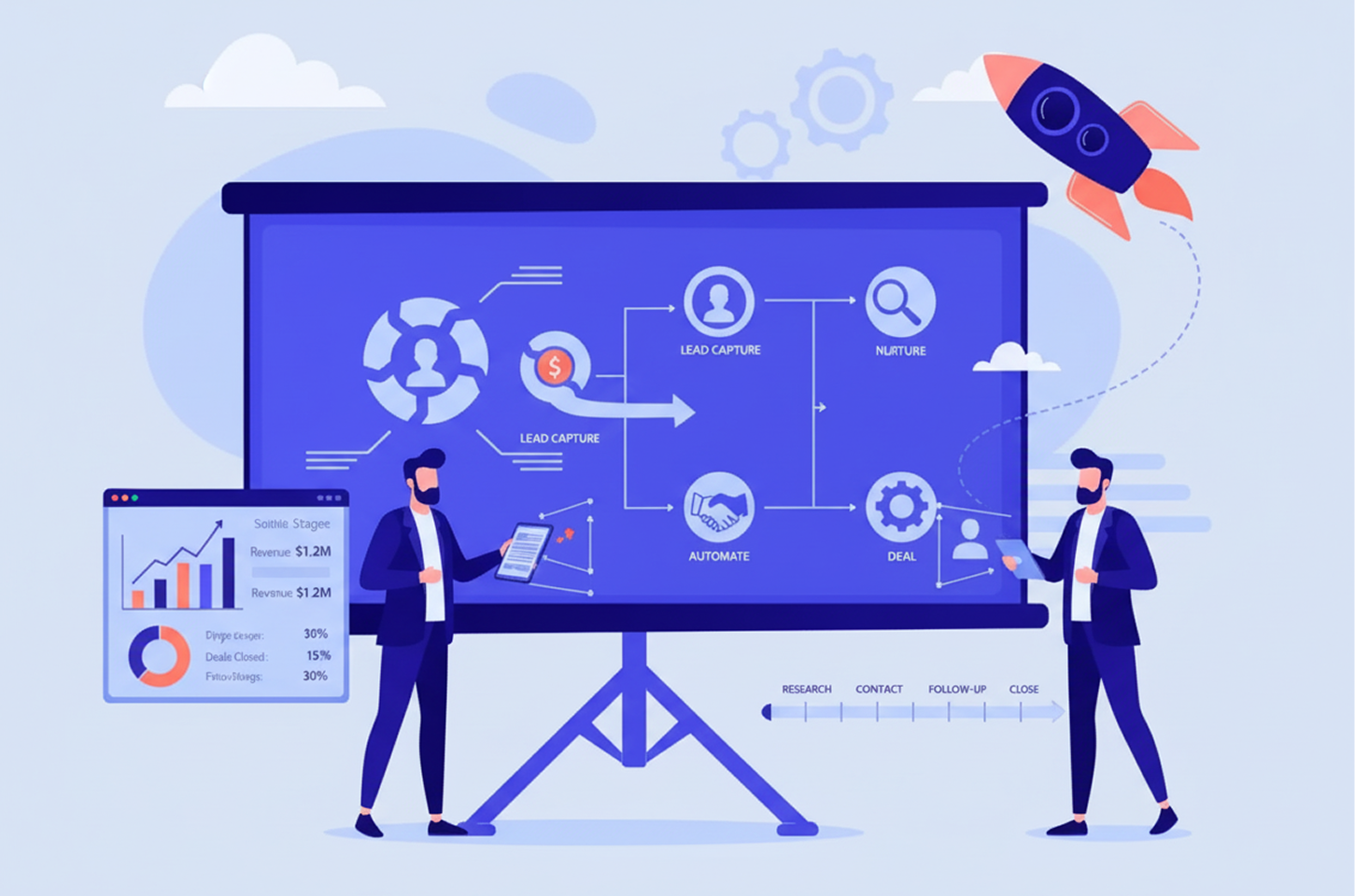
Adopting AI is not merely a technological upgrade. It represents a structural shift in how organizations operate, make decisions, and scale performance.
An AI-first organization embeds intelligence into everyday workflows — across sales, delivery, operations, and leadership.
Step 1: Centralize Data and Workflows
Fragmented systems limit AI effectiveness. Successful AI adoption begins with unifying:
Revenue workflows
Project execution systems
Operational data streams
A centralized platform creates the foundation for meaningful intelligence.
Step 2: Introduce AI Managers as Assistive Intelligence
AI should augment human capability, not replace it.
Intelligent managers can:
Surface real-time insights
Identify risks early
Automate repetitive coordination tasks
Provide performance summaries
This frees teams to focus on strategic thinking and execution.
Step 3: Build an Intelligence Culture
Technology alone is insufficient. Organizations must:
Train teams on AI-powered tools
Establish data-driven decision frameworks
Encourage experimentation with automation
Align leadership around measurable performance indicators
Step 4: Scale with Predictive Systems
As organizations grow, complexity increases. AI-first systems provide:
Predictive forecasting
Automated workflow triggers
Continuous optimization
This ensures that growth does not introduce operational chaos.
The Long-Term Advantage
AI-first organizations gain:
Increased efficiency
Stronger execution consistency
Greater transparency
Faster strategic decision-making
The competitive edge of the next decade will belong to companies that embed intelligence into their operational DNA.

Building the underlying operating system for the autonomous enterprise. Powering the next generation
of business leaders.


© 2026 PERSTOC.AI ALL RIGHTS RESERVED.